06 Jun 2020: Audio Advice of Shaykh Abu Iyad to Maldivian Salafis Regarding the COVID and Vaccine Fitna, Unity, and Obedience to Authorities — Strong Proof Against His Relation to the Fitna in the Maldives and the Public Agitation He Was Accused Of by Followers of Arafat

Introduction: The True Origins of the Maldivian Fitna (May 2019 – Early 2020)
To accurately understand the events surrounding the fitnah that occurred among the Salafīs in the Maldives during the COVID-19 pandemic, a precise timeline must first be established. Long before any involvement from Shaykh Abū Iyāḍ—Amjad Rafīq—the Salafīs in the Maldives were already grappling with a severe internal fitnah arising from the harsh and deeply harmful conduct of Abū Anas Muḥammad ibn Ḥasan.
On numerous occasions, senior Salafī brothers convened meetings to discuss sending him back to his island and terminating the financial support provided to him. He had been kept in Malé through a salary and rented accommodation, and this support has continued from that time until the present day. Such discussions took place as early as 2013, yet despite the repeated concerns raised, no one was able to carry out the decision. I sincerely advise my beloved Salafī brothers to distance themselves from him. We have witnessed sufficient damage to the daʿwah arising from his conduct, from numerous angles, both within the Maldives and abroad.
This initial division involved Dr. Arafat Muhammadi and his fiercely fanatical followers (mutaʿaṣṣibīn)—chief among them being Abu Anas in the Maldives, Adiyyu Muhammad, and other students studying in Madinah. During this period, a faction of those who ascribed to Salafiyyah in the Maldives behaved toward other Salafī brothers holding anti-vaccine views with harsh, intolerant and extreme attitudes. It should be noted that Adiyyu had previously worked at the Abdul Samad Memorial Hospital before traveling to study in Madinah, and thus he harbored a strong pro-vaccine inclination.
The situation escalated when these Salafī brothers were holding discussions in a 2019 Viber group titled “Are vaccines safe?”. Within this group, a Salafī brother who had extensively studied the harms of vaccines and held relevant certifications was speaking purely from a medical perspective. Rather than responding with knowledge and composure, this pro-vaccine faction became heavily agitated.
Joining this agitation was an individual residing on a remote island who had previously studied in Pakistan and claimed an ascription to Salafiyyah. On other occasions, he had expressed his disapproval of the duʿāt of Salafi Publications by circulating a speech of Dr. Waṣīyullāh ʿAbbās against Shaykh Abū Khadījah. Together with others, he unjustly accused the brothers in this group of deviating from the Salafī manhaj, labelled them Khārijites, and falsely claimed that they were rebelling against the rulers—all merely because they held a different medical view regarding vaccinations and discussed the matter within a Viber group.

Sep 2019
Seeking to rectify this turmoil, the brothers involved in the dispute held a sitting with Dr. Arafat Muhammadi and Abu Anas in Madinah during a 2019 Umrah trip. Unfortunately, even upon returning from the trip, the affair remained unresolved. This was due to the poor manner in which the situation was handled by Abu Anas, Adiyyu, and others, ultimately leaving the community fractured and vulnerable.
When the COVID-19 pandemic subsequently struck in early 2020, the situation deteriorated further. Certain students studying in Madinah, such as Adiyyu Muhammad, adopted those exact same harsh and intolerant characteristics—most probably due to the influence they had received from the followers of Yaḥyā al-Ḥajūrī and Arafat himself. They applied this harshness in their dealings with the Maldivian Salafīs who held different views, as well as in their treatment of other Salafī duʿāt, such as Shaykh Abu Iyad, whom they knew to hold a sceptical, anti-vaccine stance. When some individuals expressed skepticism about the pandemic—claiming COVID was a pre-planned hoax or struggling to accept the mainstream narrative regarding the existence of the virus—these students and their followers reacted with extreme harshness. They began writing and propagating that holding such views was akin to opposing Salafī scholars, opposing the religion itself, opposing the governments and rulers, looking down upon the ‘Ulamā, and manifesting extremism (ghuluww) in the religion.
The April 2020 Agitation of Adiyyu and Our Response
As undeniable proof of this reality, on the 1st of April 2020, Adiyyu wrote the following message in the “Ikhwatul Salafiyyoon” group—a platform containing over 200 Maldivian Salafī brothers:
“The scholars have described this COVID virus as one of Allah’s armies. Thinking that this virus is ‘normal,’ or believing that the states and countries are only playing (with lockdowns, mosque closures, etc.), or that doctors and scientists are being discredited, and based on that, thinking the scholars were mistaken, or the Muslim rulers were mistaken, and thinking you are more knowledgeable than them: this is extremism [in the religion.] This is advice I have written to protect myself before Allah. Whoever believes it, let him believe it. Whoever does not, let him leave it.”
In response to this extreme rhetoric, brother Muʿādh replied at length, rebuking his harsh speech. Subsequently, I (Ismāʿīl) dispatched the following clarification to the group:
“May Allah reward you, brother Muʿādh. Yes, as Muʿādh said:
Just because someone views this medical issue in a different way, or evaluates the seriousness of this disease differently, it is wrong to label such brothers as extremists in religion, or to claim they are being disrespectful toward the scholars and rulers, or that they are thinking themselves superior to others. Such accusations have only caused hurt and harm among us.”
I then continued, addressing Adiyyu’s false assumptions:
“After reading what ʿAdiyyu wrote, it seems that this is how he believes Ustādh Abu Iyāḍ is approaching the issue. But this is only his personal thought. To clarify the matter, here is the actual writing of Ustādh Abu Iyāḍ (حفظه الله):
INSIGHT INTO CORONAVIRUSES AND ILLNESS: Part 1 ‘Human coronavirus circulation in the United States 2014–2017’ “
This disproportionately harsh and oppressive treatment led to severe emotional fallout. Individuals who were already emotionally impacted by the severe COVID-19 lockdown measures, and who felt unjustly attacked by this group’s harsh and intolerant reactions, began writing reactionary, emotional speeches on social media and private groups.

As clear visual proof of this chaotic environment and the discussions taking place, we present screenshots from a social media group titled “Healthy Salafi Brothers K”. In these exchanges, after an audio of Shaykh Abu Iyad explaining the scientific realities of the vaccine was shared, the extreme labeling from the opposing faction triggered intense frustration. A brother, reacting to their oppressive behavior—specifically their false claim that sharing scientific facts meant opposing the scholars—is seen defending Shaykh Abu Iyad, questioning in sheer disbelief:
“Is brother Abu Iyad حفظه الله going against the scholars talking the truth about vaccine.??!!! With known facts.. He is Salafi & an expert in this field. We still hardcore WHO??!!”
This exchange perfectly captures the severe agitation and emotional back-and-forth that was occurring. Those with harsh and intolerant views began to make complaints to shaykhs in Madīnah. They falsely claimed that Abu Iyaad was the cause of these problems, despite the fact that he never had any contact with anyone in Maldives regarding this matter and the controversy over these issues predates Covid-19. Likewise, a brother from the Maldives reached out and contacted Abu Iyaad, explaining this situation. After Abu Iyaad learned of these problems for the first time, he provided his recorded advice to the Maldivian Salafīs to extinguish the flames of this fitnah.
The Confession: Adiyyu’s Admission of Making Imtiḥān
To further prove that this severe environment of testing and boycotting existed from their side, we can look to the very words of Adiyyu himself. In a message sent years later on May 5, 2025, Adiyyu explicitly admitted to the extreme state of affairs that this faction had created, stating:
“‘[Do the Salafīs] take the vaccine?’ To this extent, the people were subjected to a test (imtiḥān)… Furthermore, because of this issue, ties [of brotherhood] were affected (applying al-walāʾ wa-al-barāʾ — loyalty and disavowal).”
We had anticipated long beforehand that if this tribulation (fitnah) regarding the vaccine and contagion (ʿadwā) was not stopped, it would reach this extent. Initially, when advice (naṣīḥah) was given, disparaging remarks were directed at us. (referring to our April 1st, 2020 rejection of his extreme rhetoric). Then, now it is Shaykh ʿArafāt [who is being attacked]… and tomorrow, if this continues without stopping, it will escalate even higher than that.
In the very same message, Adiyyu ironically attempts to shift the blame onto Abu Iyad, questioning his adherence to the authorities during the pandemic:
Every single time the Shaykhs issue a refutation (radd), the individuals to whom those refutations are directed bring forth the exact same argument: ‘Out of context,’ [or] ‘misunderstood.’ Then, when this is not enough, [they claim] that the Shaykhs are lying. If Ismāʿīl Rafīq has the audacity to speak out against Shaykh ʿArafāt without reflecting independently, then a day may come where he will have the audacity to commit matters even graver than this. While Ismāʿīl speaks against the Shaykh in this manner, will the others in Abu ʿIyād’s group also behave in this same way? What does this imply regarding Abu ʿIyād and his group?
When Shaykh ʿArafāt was most recently asked about this issue, the Shaykh stated that Abu ʿIyād had retracted (rujūʿ) from those statements and repented (tawbah). I asked the Shaykh if there was an English written document of this. The Shaykh did not say anything [in response]. After that, we stopped discussing the matter. However, now this affair has started up again and has escalated much further.
When Abu ʿIyād and those with him acted during such a critical period, which Shaykh did they consult (mashwarah)? Did they not determine its benefits (maṣlaḥah) and harms (mafsadah) entirely on their own? Did He independently deem it the correct time to write or speak openly and publicly regarding an issue of such magnitude? Where are the scholars and the rulers who are appointed to speak on the overarching affairs of the Ummah? Even if there is no Muslim ruler in the UK, have you forgotten that they exist in the Muslim countries? The negative consequences of those actions continue to extend up to this very day. That action of yours, Ismāʿīl Rafīq, is also a direct result of it. Today, every common person has the audacity to speak out against the Shaykhs and the people of knowledge.
This message stands as a decisive proof against them from their own mouths.
Firstly, Adiyyu openly acknowledges that they were subjecting Salafīs to an imtiḥān over a worldly medical issue and severing the ties of brotherhood based upon it. Furthermore, when he complains of “disparaging remarks” being directed at them, he is referring directly to the events of April 1st, 2020. He views our calm, factual request for moderation and our quotation of Shaykh Abu Iyad’s actual writings as a “disparaging attack.” To them, correcting their extreme behaviour is seen as an assault.
Secondly, it exposes the reality of his motivations: notice how Adiyyu’s primary concern throughout the message is his fanatical defense of “Shaykh ʿArafāt.” This blind, partisan allegiance (taʿaṣṣub) to Arafat is the true driving force behind their extreme behavior.
Thirdly, his accusation that Abu Iyad acted contrary to the rulers and scholars is utterly dismantled by the 06 Jun 2020 audios. As the transcripts below will prove, Abu Iyad’s direct advice to the Maldives was the exact opposite of what Adiyyu claims: it was an explicit, uncompromising command to obey the Muslim rulers and the scholars in whatever COVID guidelines they implemented.
The Accusation vs. The Documented Reality
Recently, a false narrative was propagated by Muhammad bin Khalifah on the platform ‘X’, wherein he attributed a statement to Dr. al-Bukhārī (may Allāh Aid him), claiming:
“I entered upon our Shaykh, the ʿAllāmah ʿAbdullāh al-Bukhārī—may Allāh preserve him—shortly after COVID, and I found him angry regarding a man called (Abu Iyad) Amjad and the division he caused in the Maldives and Indonesia. I did not know him except by his kunyah. I then said to him, ‘Our Shaykh, this is a man who has efforts [in the Daʿwah], and they say he is a specialist in these subjects.’ I tried to calm the situation out of preservation for the blessed Daʿwah they had built for decades, and because of the love our elders held for them. Then, the Shaykh said—with the wisdom and baṣīrah (insight) of a father: ‘If he is an expert in pandemics, then let him write his opinion and his research and send it to those whom Allāh has placed in authority over us, and to the Ministries of Health; he would then have fulfilled his obligation. As for this public agitation (tashwīsh), it can only be from an infiltration (dasīsah).“
To claim that Abu Iyad was the cause of “division in the Maldives and Indonesia,” and to accuse him of “public agitation (tashwīsh),” is a severe distortion of the facts.
The reality of the affair is that the division had already occurred entirely due to how this faction, resembling the extreme harsh and intolerant approach of the Haddādiyyah, behaved toward other Salafīs in the Maldives long before Abu Iyad was ever contacted. Rather than causing division, Abu Iyad’s intervention was a direct effort of iṣlāḥ (rectification) to put an end to the public agitation and reunite a community fractured by the harshness of others.
Visual Evidence & Corroboration
To substantiate the reality of Abu Iyad’s intervention, the attached screenshot serves as undeniable visual, time-stamped proof of the timeline, audience, and intent of his advice.

The image displays a WhatsApp conversation dated June 8, 2020. It features three forwarded audio files, with the accompanying text explicitly stating: “Mi dhimaa v kanthah thaku ga Abu Iyad حفظه الله ge advice thakeh Maldivian brothers ah” (Advice from Abu Iyad regarding these current affairs for the Maldivian brothers).
The captions provided by the forwarder perfectly mirror the transcribed audio:
- Audio 1: “on rulers, scholars, unity.”
- Audio 2: “on calamities / sins”
- Audio 3: “on having different views / friction / being responsible.”
This digital footprint definitively proves that Abu Iyad’s immediate response to the crisis was to establish order upon the foundations of the Sunnah, directly contradicting the claim that he sought to cause division or tashwīsh.
Furthermore, a careful examination of the WhatsApp screenshot reveals another crucial detail: Abu Iyad explicitly conveyed his greetings to Abu Anas, writing,
“Wa alaykum as salaam. Give my salaams to Abu Anas and all the brothers. From Abu iyad.”
This clearly demonstrates that at the time, Shaykh Abu Iyad harbored no ill suspicions towards him and acted upon ḥusn al-ẓann (good thoughts). To our knowledge, these very audios were forwarded to Abu Anas just as they were circulated among the rest of the brothers.
Abu Anas was fully aware of these audios and Abu Iyad’s actual advice from that very moment. Yet, despite knowing the truth, he proceeded to stab him in the back by feeding false information and fabrications to Dr. al-Bukhārī and Dr. Arafat. Such dishonest and treacherous behavior exposes the reality of his actions and the severe lack of integrity involved.
These documented proofs clear all allegations leveled against Shaykh Abu Iyad without a shadow of a doubt regarding his involvement in the Maldives. Allāhul-Mustaʿān (And Allāh is the One whose help is sought).
The Primary Evidence: Full Transcripts of Shaykh Abu Iyad’s Advice (06 Jun 2020)
Below are the complete, unabridged transcripts of the three audio files sent by Abu Iyad to the Maldivian Salafis. They prove, in his own words, that he commanded obedience to the rulers’ COVID guidelines, warned against social media agitation, and demanded that differing views on medical issues must not cause splits in the Daʿwah.
Also, Abu Iyaad’s writings were a response to the false claims and exaggerations of certain students in the US and the UK who had displayed behavior which was similar to that of the fanatics in the Maldives and they began to accuse him with the same things.
🎙 Transcript: Audio 1 – On Rulers, Scholars, Unity
[06 Jun 2020 – Advice to Maldives Salafi Brother on Fitna surrounding Covid and Vaccine Issues]
بسم الله والحمد لله والصلاة والسلام على رسول الله وعلى آله وصحبه ومن والاه.
This is some advice regarding this current trial and tribulation (of Covid), as (Major Scholar) Sheikh Salih al-Fawzan has described it. And there are numerous points I want to convey.
The first of them is to do with unity, differing, and splitting, and the foundations of the Sunnah as it relates to obeying the rulers and the scholars. So, I want to repeat what I’ve said from the very beginning two or three months ago, which is that:
- It’s obligatory upon every Muslim, in every Muslim country, to obey the Rulers.
- And in whatever guidelines they have implemented,
- Whatever regulations they have placed,
- Whatever restrictions they have made,
- It is obligatory upon a Muslim to obey them and not to disobey them.
- And likewise, the scholars have ordered the people, have advised the people that they stick to what the rulers have put in place.
- And the scholars have said this on the basis of the Sunnah—the Sunnah of the Messenger of Allah (ﷺ).
And from the greatest foundations of the Sunnah, as, Shaykhul Islam Muhammad bin Abdul Wahhab (Rahimahullah) in Al-Usul Al-Sittah, the second and third principles are related to unity: unity in the religion and unity behind the ruler. And the texts in this regard are very many. Allah (Azza wa Jal) He said:
وَلَا تَكُونُوا۟ كَٱلَّذِينَ تَفَرَّقُوا۟ وَٱخْتَلَفُوا۟ مِنۢ بَعْدِ مَا جَآءَهُمُ ٱلْبَيِّنَـٰتُ ۚ وَأُو۟لَـٰٓئِكَ لَهُمْ عَذَابٌ عَظِيمٌ
(Do not be like those who split and differed after the clear evidences came to them. They are the ones for whom is a mighty punishment.)
And the statement of Allah (Azza wa Jal):
وَلَا تَنَـٰزَعُوا۟ فَتَفْشَلُوا۟ وَتَذْهَبَ رِيحُكُمْ ۖ
(Do not dispute so that you lose courage and that your strength disappears.)
And the Messenger of Allah (ﷺ) he said:
يَدُ اللَّهِ مَعَ الْجَمَاعَةِ
(The hand of Allah is over the Jama’ah.)
And likewise the Messenger of Allah (ﷺ) he said:
مَنْ أَرَادَ بُحْبُوحَةَ الْجَنَّةِ فَلْيَلْزَمِ الْجَمَاعَةَ، فَإِنَّ الشَّيْطَانَ مَعَ الْوَاحِدِ، وَهُوَ مِنَ الِاثْنَيْنِ أَبْعَدُ
(Whoever desires the uppermost part of Paradise, then upon him is the Jama’ah. For indeed, Shaytan is with the solitary person—the person by himself—and he is further away from two, when there are two.)
Likewise, the hadith:
وَالْجَمَاعَةُ رَحْمَةٌ، وَالْفُرْقَةُ عَذَابٌ
(The Jama’ah is mercy and splitting is punishment.)
All of these, these are just some of the texts; there are very many other texts, which command with unity and likewise hearing and obeying the ruler. Ibn Umar (Radiyallahu Anhu) said that the Messenger of Allah (ﷺ) he said:
عَلَى الْمَرْءِ الْمُسْلِمِ السَّمْعُ وَالطَّاعَةُ فِيمَا أَحَبَّ وَكَرِهَ، إِلَّا أَنْ يُؤْمَرَ بِمَعْصِيَةٍ، فَإِنْ أُمِرَ بِمَعْصِيَةٍ فَلَا سَمْعَ وَلَا طَاعَةَ
(Upon a Muslim man is to hear and obey in whatever he loves, likes, and whatever he dislikes. Unless he is commanded with disobedience, then there is no hearing and no obeying.)
And the hadith of Abu Hurayrah (Radiyallahu Anhu) who said that the Messenger of Allah (ﷺ) said:
مَنْ أَطَاعَنِي فَقَدْ أَطَاعَ اللَّهَ، وَمَنْ عَصَانِي فَقَدْ عَصَى اللَّهَ، وَمَنْ يُطِعِ الْأَمِيرَ فَقَدْ أَطَاعَنِي، وَمَنْ يَعْصِ الْأَمِيرَ فَقَدْ عَصَانِي
(Whoever obeys me has obeyed Allah, whoever disobeys me has disobeyed Allah, whoever obeys the Amir he has obeyed me, and whoever disobeys the Amir then he has disobeyed me.)
In all of this, even if there are difficulty and hardship and restrictions and problems which are created and so on so forth, we still have to obey the rulers. And this is because we are people of the Sunnah, we follow the Sunnah, we value the Sunnah, and we know the Sunnah is guidance; it is rectification, it contains benefit for the society as a whole. And the rulers have been given a very special position because Allah (Azza wa Jal) brings about by way of the rulers, such a safety and security and, order and, facilitating livelihoods which otherwise, otherwise there would be chaos.
So even if we find hardships and difficulties in some of the affairs that the rulers may implement for a certain reason or for a certain period of time, then we have to abide by that. We have to control our emotions, we have to control our feelings. That’s why all of these ahadith have come in the Sunnah of the Messenger of Allah (ﷺ) which mention these affairs and give guidance in these types of affairs. So, the way that a person of the Sunnah looks at this situation is a test. This is a test. I claim to be following the Sunnah; now this is a test to see are you going to obey the Sunnah?
So, basically all of the restrictions, all of the guidelines, all of the regulations which have come, then you have to abide by them. Even here in the West, in the Western countries, we have to do the same. we have to do the same. [Note: Not only did Shaykh Abu Iyaad advise people to obey the Muslim rulers but also that we need to follow the law of the land even in non-Muslim countries]
So anyway, this is the first point I wanted to make: this is about obeying the ruler, unity, not differing, not splitting, not causing a commotion, controlling your feelings and your emotions, and putting the Sunnah above everything else. So, if we start with this point and we, we value this point and we adhere to this point, then this will be, this will be, goodness and rectification. And this is actually the very first point, in the very first article which I, put out that everyone as this situation develops everyone must obey the rulers, in in their countries, in the Muslim countries, and not to oppose them. So anyway, that’s the first piece of advice that I give, and I’ll discuss the second piece of advice after this Insha’Allah Ta’ala.
🎙 Transcript: Audio 2 – On Calamities / Sins
[06 Jun 2020 – Advice to Maldives Salafi Brother on Fitna surrounding Covid and Vaccine Issues]
The second point I want to add is simply to repeat what (Major Scholar) Sheikh Salih al-Fawzan (Hafidhahullahu Ta’ala) mentioned at the very beginning, and I translated his article and spread this article. Basically, that we should see these trials as a consequence of sins and disobedience. And instead of pointing fingers, at this disbeliever, or this organization, or this and that, we have to first look at the true and real causes of why trials and calamities come upon us. And this is from the wisdom of Sheikh Salih al-Fawzan that he mentioned this issue in his statement, and he mentioned the Battle of Uhud as an example to illustrate that, we have to look at ourselves first and foremost.
So, in this regard, I just want to mention a statement from Ibn al-Qayyim (Rahimahullahu Ta’ala) in Al-Fawa’id where he mentions this point, the similar point. He says:
اقْشَعَرَّتِ الْأَرْضُ، وَأَظْلَمَتِ السَّمَاءُ، وَظَهَرَ الْفَسَادُ فِي الْبَرِّ وَالْبَحْرِ مِنْ ظُلْمِ الْفَجَرَةِ، وَذَهَبَتِ الْبَرَكَاتُ، وَقَلَّتِ الْخَيْرَاتُ، وَهُزِلَتِ الْوُحُوشُ، وَتَكَدَّرَتِ الْحَيَاةُ مِنْ فِسْقِ الظَّلَمَةِ، وَبَكَى ضَوْءُ النَّهَارِ وَظُلْمَةُ اللَّيْلِ مِنَ الْأَعْمَالِ الْخَبِيثَةِ وَالْأَفْعَالِ الْفَظِيعَةِ، وَشَكَا الْكِرَامُ الْكَاتِبُونَ وَالْمُعَقِّبَاتُ إِلَى رَبِّهِمْ مِنْ كَثْرَةِ الْفَوَاحِشِ وَغَلَبَةِ الْمُنْكَرَاتِ وَالْقَبَائِحِ.
(The earth and the heaven, the earth has shaken and the heaven has become dark, and mischief has appeared upon the land and the sea because of the oppression of the sinful people. And the blessings have gone, the goodness has become little, and life has become kind of impure or blemished because of the sin of the oppressive people. And the light of the day and the darkness of the night are both crying. They are crying because of the evil, filthy actions and the harmful actions which are being committed in the night and the day. So, the night and the day are crying because of the actions which are being done, and the angels who write, they are complaining to their Lord because of the fawahish, the evil, the munkarat, the vile things which are taking place. Even the angels are complaining to their Lord.)
He says:
قَسَتِ الْقُلُوبُ، وَكَثُرَتِ الذُّنُوبُ، وَانْصَرَفَ الْخَلْقُ عَمَّا خُلِقُوا لَهُ
(Basically, the hearts have become hard, the sins have increased, and the creation has turned away from the purpose and the reason for which they were created.)
فَعَظُمَ بِذَلِكَ الْمُصَابُ، وَاسْتَحْكَمَ الدَّاءُ، وَعَزَّ الدَّوَاءُ
(So, the calamity or the hardship has become great, the disease has become firmly set in, and the cure has become difficult.)
وَهَذَا وَاللَّهِ مُنْذِرٌ بِسَيْلِ عَذَابٍ قَدِ انْعَقَدَ غَمَامُهُ
(So, this, all of this is basically, it’s like a warning that the punishment is on its way. When you see the clouds in a distance that they become dark and gloomy and they are coming your way—it’s a bit like this, that all of this sin and disobedience is a sign that punishment is coming your way.)
وَمُؤْذِنٌ بِلَيْلِ بَلَاءٍ قَدِ ادْلَهَمَّ ظَلَامُهُ
(And it’s an announcement that a night of calamity is coming whose darkness has become very severe.)
Now this statement from Ibn al-Qayyim (Rahimahullah), it allows us to have a proper perspective and understanding of everything that happens around us. Right, before we start pointing fingers at this person (Like Bill Gates etc.) and this disbeliever and that organization (Like WHO etc.)—that might be true, that might be true. But these are simply individuals or organizations that Allah (Azza wa Jal), He is the one who controls them, He is the one who mobilizes them, He is the one who uses them to bring about, hardships and calamities and oppression against others from His servants because they deserve that because of their sins.
So, before we start pointing fingers here and there, we should turn to our souls, ourselves, and look at our shortcomings, look at our sins, look at whether our hearts, are really and truly subservient to Allah (Azza wa Jal). Look at our neglect of our obligations, that we fall into sins. This is the true and real reason why we suffer hardships and difficulties, and things of that nature.
And this is the difference between us and the people of innovation, the people of misguidance, because they don’t understand these affairs. They don’t understand the Sunnah, they don’t value the Sunnah, and so therefore
- they start speaking against the rulers,
- they start opposing the Sunnah because they are not able to control their feelings and their emotions,
- because they do not understand the laws and the rules of Allah in His creation.
Right, so this is the second point I want to emphasize. First of all, we value the Sunnah.
- We obey the rulers in that which they command.
- And likewise, this is what the scholars have advised with.
And secondly, we understand the realities of the affair: that all of these hardships and difficulties, they are brought about—Allah is the one, Allah (Azza wa Jal) is the one who is in control. Allah is in control. He is the one who mobilizes people, He is the one who turns the hearts, He is the one who either gives you security (al-amn) and sustenance (ar-rizq) or He is the one who removes it. He gives you hunger (al-ju’) and fear (al-khawf) and lack of sustenance. Allah (Azza wa Jal) is the one who is turning all these events, it is Allah (Azza wa Jal) who is turning all these events.
So in times of hardship like this, then we turn to Allah, and our hearts turn to Allah. This is the first thing Muslim Should be thinking of, in which he should be telling his family, in which he should be speaking to his relatives regarding this matter. Not this person is behind this or that person is behind this, all of that is true, could be true. But the priorities have to be correct. If you lose priorities, focus your activity in just one area, then you will start making mistakes.
This is the second point I want to add; this is the issue of calamities, and we have to know what the true cause and true reason behind these calamities and focus our attention on this. Because sometime these other things way bigger than individual person. One person is not going to solve all of these problems; you have to be eager for the things that is going to benefit you the most and your family the most. And that start with ah-Tawbah (making tawbah) and istighfar (seeking forgiveness), and inabah, and taqwiyatul iman, strengthening your Eman and turning to Allah, strengthening your iman. This is what is going to benefit you in the trials and tribulations, which could come further down the line.
So, this is the second point of advice I would like to give.
🎙 Transcript: Audio 3 – On Having Different Views / Friction / Being Responsible
[06 Jun 2020 – Advice to Maldives Salafi Brother on Fitna surrounding Covid and Vaccine Issues]
“The third point, the third piece of advice relates to this whole issue of, where differences exist and have appeared on the issue of vaccination, for example, the issue on this, the epidemic or the pandemic, the COVID or the coronavirus.
These are issues in which you find across the world there are differences, and these differences are between specialists, people who are very highly qualified, and they have the status and the ability and the expertise to speak on these issues.
And so, there are differences in vaccination; some people are pro-vaccine, some people are anti-vaccine and likewise on this issue of, the coronavirus, there’s much discussion and debate and it’s out in the open, it’s nothing hidden.
There are politicians speaking about this in the parliaments, there are many, many specialists, microbiologists, epidemiologists, there are scientists, there are so many people speaking about this, and obviously there are different views and different understandings of this particular issue.
Now, one of the important things that has to be mentioned here is that;
- These differences should not create friction.
Because, you can be pro-vaccine, you can be anti-vaccine, and if you’ve done the research and if you are comfortable with that view and you hold it to be correct, that’s good for you, that’s good for your family, that’s good for your friends if you speak to them.
- But you cannot force anybody to hold your opinion.
Just like they cannot force you to hold your opinion. This is a matter of discussion, this is a matter of, each person trying to find out the truth as much as he or she is able. And then, acting in accordance with that for the benefit of his family or her family.
So, these issues should not create friction. I have many, many, I have friends, doctors, relatives, they have mixed views, some of them hold the view that vaccination is okay, others hold the view no it’s not, it’s harmful, it doesn’t really benefit. But this, this isn’t a matter where you now make this the basis, for creating friction and this is this is part of the worldly affairs,
- this is not the foundation that we use to build loyalty or disloyalty (al-wala wal-bara).
So, these issues should not be creating friction.
Now as for the issue of, speaking about these issues:
These controversial or sensitive issues, first of all, point number one is that if you have specialist knowledge, if you are qualified to speak on these issues and you have a background, in science or whatever it might be, that’s fine , then, you can investigate, you can research, you can analyze, you can speak to your family, you can speak to your friends.
- This type of discussion, there’s nothing unlawful about this discussion.
This is no different to, for example, if you want to be involved in a trade or a business, then you research, you analyze, you find out, you investigate and you decide is this for me, is this not for me. And the same with diet and nutrition, you research what type of food is good, what type of food is bad, what type—these are worldly affairs that every person has a right to investigate and study because it relates to their welfare.
But as for now trying to use this to force things on other people, and having splits and friction and, this this is not good.
Because everybody has a different background, everybody has a different experience, everybody has different levels of knowledge. Some people grasp certain things; other people don’t grasp certain things. The level of understanding is different amongst people, and so some people are going to, have a certain view, others will have a different view. But you cannot use this now to, create friction and splitting and, affecting your brotherhood just because of this.
As for the issue of whether, like when when you speak about this and you want to, speak to other people or you use social media and things like that, now this is where you have to be responsible. You have to be responsible. You cannot allow your emotions to affect your behavior and to escalate this more than what, to escalate this further.
If you are a specialist with knowledge and you want to share that knowledge with somebody else, nothing can—there’s nothing to stop you from doing that. If you believe that taking Vitamin D, for example, is beneficial for health or beneficial for a cold or a flu or for this disease, that’s fine, you can spread that knowledge. People don’t have to agree with you, but you can spread that knowledge.
If you believe that vaccination is harmful and you have specialist knowledge, or you are able to quote and cite specialist knowledge and you want to convey that, that’s fine. I mean, this is not unlawful in non-Muslim countries, I don’t believe it’s unlawful even in Muslim countries.
Muslim countries, if the ruler specifically says to you, “I prohibit you from speaking on this issue,” like you as a person, and the law says that in a Muslim country, then, you should abide by that law. But if there’s nothing that prohibits you from discussing these types of issues, whatever view you hold, then you should do that, responsibly.
Without letting your emotions and your feelings and, your stubbornness to come into this. Don’t do things which are, which are not necessary. If you want to convey a piece of research, a piece of information, a report, from a specialist or from a body, then you can do that. There’s no harm in doing that, no one can stop you from doing that, as long as you are qualified and you are sharing beneficial information, no one can stop you from doing that.
But as for going a step beyond this and falling into schisms and friction and, wanting the other person to accept your view, this you can never achieve, you can’t achieve this. I mean think about it, in the Quran, Allah (Azza wa Jal) mentions to the Messenger of Allah (ﷺ) that, you cannot guide those whom you love.
إِنَّكَ لَا تَهْدِي مَنْ أَحْبَبْتَ وَلَٰكِنَّ اللَّهَ يَهْدِي مَنْ يَشَاءُ ۚ
(Indeed, you do not guide whom you love, but Allah guides whom He wills.)
Even in the issue of Tawheed, it is it is Allah (Azza wa Jal) who guides and who changes people’s hearts. And this is from the greatest of affairs, it is the clearest of affairs, it is, from the Fitrah to recognize Tawheed. And yet sometimes you want so much that your family, your relatives, your uncles, your aunties, if they are non-Muslims, you want them to be guided. But this affair is not in your hands, it’s not in your hands. Now this is with the issue of the Tawheed of Allah (Azza wa Jal). What thing is clearer and more apparent than the Tawheed of Allah (Azza wa Jal)?
So, when this is the case, then what about these kinds of issues to do with, vaccination and disease or even in like other worldly sciences? How can you expect, and sometimes these can be detailed, intricate sciences which not everybody is going to understand. So, if you have a view, then, you can discuss and explain if you have the ability, you can share information, but it shouldn’t lead to where now this is going to create friction or hardship and difficulty and, differing and, where your emotions now start coming in.
Right? If you have found what is beneficial, and you believe it to be the truth, Alhamdulillah, praise Allah (Azza wa Jal), in these matters of the world, in health medicine, praise Allah (Azza wa Jal), and, you will benefit from what you have learnt. And praise and thank Allah (Azza wa Jal). You don’t have to convert the rest of the world necessarily; you don’t have to convince the rest of the world. You can discuss, but you don’t you don’t need to get your emotions involved just to make a point, and especially not to go on social media and to do things which are not really befitting, and, then you are just undermining your own position by doing things which are not befitting.
So, this is the third point I want to mention, that basically, if you want to speak on these issues, first of all, you should be a specialist, you should have knowledge and understanding. Secondly, that it’s not necessary for you to spread everything or say everything, or, to want to convince everybody of your view.
You can share information like a report or an article which relates to for example, what medication can I take for this, what medication can I take for that. Sharing of information there’s nothing wrong with that. When it comes to these worldly affairs as long as, the information is credible and it has a basis. And you don’t need to convince everybody of your view. But, as it relates to, you can’t create commotion and agitation, and rouse people’s anger, and things like that, just because they don’t accept your view. Just because they are not accepting your view.
Right? So, this is the third point I want to mention that these issues should not lead to this kind of controversies and friction, and not everybody should be talking about these issues. And obviously there is a difference between Muslim countries and non-Muslim countries. In Muslim countries there are specific circumstances and in non-Muslim countries there are specific circumstances.
So, you can’t treat these two different types of places to be exactly the same. You have to behave responsibly and you can’t let your emotions get the better of you, and just because you have a view doesn’t mean that you have to like in a very angry emotional way, this this is wrong and it just leads to people having splits and differences.
Anyway, that’s the third point that I want to mention, about these kinds of issues vaccination and things like that, and you have to behave responsibly, and don’t speak unless you have knowledge. And not everything, you don’t have to convince other people of it. If it’s beneficial to you and your family, Alhamdulillah, praise Allah and act upon that. And if you want to discuss things between yourselves, that’s fine, there’s nothing unlawful about that to discuss issues of health and medicine, as long as what you are saying, what you are speaking, and that it doesn’t lead to creating commotion and agitation.
And these kinds of things, shouldn’t spill into social media where you are expressing your anger and your emotions and your feelings like this, by way of social media. Avoid that, because that that is basically harmful. Benefit yourself, your family, praise Allah for that, and, if someone else has a different view or is not listening to you, Alhamdulillah, this is a matter of the world, it’s a matter of the world, in medicine, in health, in everything there’s going to be differences.
So, anyway that’s the third point that I want to mention, about this, do not be a cause of friction between yourselves and, this only leads to weakness and splitting. And, like even, like I said amongst ourselves, I have many relatives, many friends, many people, they have all different views, I have a view, and we don’t split and have friction just because of this. If you have knowledge and ability, you can explain, have a discussion, but do not become angry just because someone else is not accepting your view. So anyway, this is the third point, third piece of advice.
Further Proof of Consistency: Advising the Authorities Upon the Salafī Way
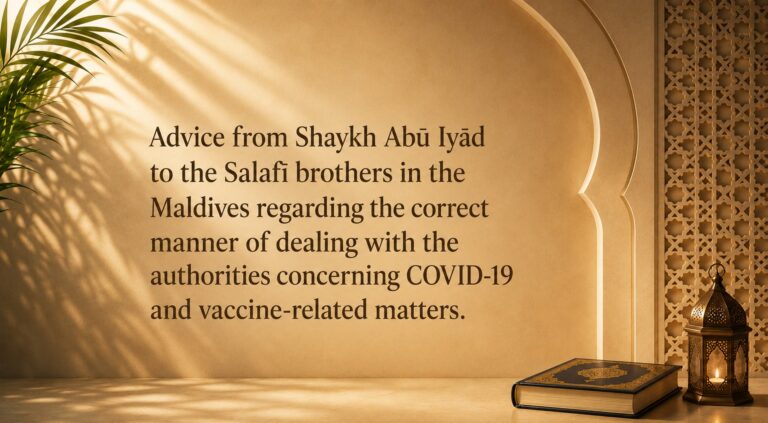
To further solidify the reality of Shaykh Abū Iyāḍ’s stance, and to show how his approach practically contradicts the false accusations of inciting tashwīsh (public agitation), we present another piece of general advice he sent to the Maldivian Salafī brothers regarding the correct manner of addressing matters connected to COVID-19, vaccines, and government policies.
This advice concerned the method of publicly tagging government officials and ministries on Twitter (X), even when done respectfully, without rudeness, and with a sincere intention to raise concerns regarding vaccine-related matters. Although the intention may be simply to raise awareness about potential harms and not to rebel against or incite against the authorities, publicly tagging officials and making specific accusations against them is completely contrary to the correct Salafī approach.
Shaykh Abū Iyāḍ advised:
“This conduct—openly tagging government officials and ministers—is not good and opposes the Salafī methodology. That generates dislike and resentment against the [Muslim] authorities by making specific accusations against them in public.
If you want to advise, then do so privately by collating the evidence and sending it to the relevant person or authority through private channels of communication. More broadly, you can educate your family and friends in order to generate awareness. However, as for tagging officials publicly, this is incorrect, even when it is done with good manners.
Furthermore, if nobody listens to you, or if the matter takes time to be addressed, then it is not for you to display impatience and behave in this manner, because, in effect, this becomes a complaint concerning Allāh’s decree. Advise in the legislated manner, then remain patient and leave the matter there.
We must understand that the Muslim rulers, authorities and ministers are not deliberately seeking to harm the people. They believe in these matters, such as vaccination, as does much of the world, and regard them as wonders of modern medicine and so on. Therefore, we cannot expect immediate change.
While the tide is slowly turning, we must remain patient and continue educating people about good health, Prophetic medicine, making sound decisions and other beneficial matters.
May Allāh rectify the affairs.”
This steadfast position against public agitation perfectly mirrors and strengthens the foundational audio advice he sent to the Maldivians on June 06, 2020. During the height of the pandemic’s confusion, he explicitly commanded the brothers to obey the Muslim rulers and their health guidelines, firmly warning against using social media to express anger, create friction, or cause commotion (tashwīsh). He emphasized that the Salafī principles of unity and obedience to the authorities must always supersede differing worldly opinions. Together, these pieces of advice completely dismantle the false accusations propagated by the fanatical followers of Dr. Arafat.
An important practical example of this Salafī approach is that Shaykh Abū Iyāḍ himself sent advice privately to rulers and relevant authorities concerning these matters during late 2020 and early 2021.
He did not publicize this advice at the time, nor did he use it to draw attention to himself. In fact, he did not reveal that he had taken these private steps until 2025—approximately four or five years later—and only did so in order to repel doubts, false allegations, and lies that had surfaced concerning his position. Had those doubts and false claims not arisen, the private advice he had offered to the authorities would not have become publicly known.
This demonstrates his lifelong consistency upon the correct Salafī methodology: sincere advice is delivered privately through the appropriate channels, without publicly provoking resentment against the authorities, without seeking recognition, and without displaying impatience when change does not occur immediately.
Conclusion
In conclusion, the reality of this affair is clear to anyone who examines the evidences fairly. The deep-rooted fitnah in the Maldives regarding vaccines and later COVID-19 was born from the harshness, extreme labeling, and Harsh methodologies adopted by others long before the summer of 2020. It was an environment already poisoned by severe public agitation and broken brotherhood.
When Shaykh Abu Iyad was requested to advise this troubled community, his words were aimed at fostering unity, demanding obedience to the rulers and their health guidelines, and strictly forbidding the very tashwīsh (public agitation) he is now falsely accused of creating. The claim circulated by Muhammad bin Khalifah on X is fundamentally false and is entirely contradicted by the documented reality. Abu Iyad’s intervention was not a cause of division, but a sincere effort to cure it.
Earlier Influences and the Emergence of Harsh Conduct

The reader should note that when the Ḥaddādī methodology of Abū ʿAbd al-Raḥmān Fawzī al-Baḥraynī became apparent among the Salafīs, Shaykh Rabīʿ ibn Hādī ʿUmayr al-Madkhalī did not remain silent. Rather, he wrote his refutation of Fawzī, titled:
Kashf Akādhīb wa-Taḥrīfāt wa-Khiyānāt Fawzī al-Baḥraynī, Shaykh Rabīʿ refuted him on 19 Rajab 1429 AH, corresponding to Tuesday, 22 July 2008 CE. Then, on 4th Oct 2008, Shaykh Abū Iyāḍ translated and published an English summary under the title:
“Deceitful Fawzee al-Bahraini Refuted by Shaikh Rabeeʿ”
By contrast, Abu Anas graduated from the Islamic University of Madīnah in 2009, and around 2010 or 2011, one of the earliest books he translated and circulated was a work by the Ḥaddādī Abū ʿAbd al-Raḥmān Fawzī al-Baḥraynī concerning obedience to the rulers. The author’s name, Abū ʿAbd al-Raḥmān Fawzī, was openly displayed on the cover of the original Dhivehi version. At that time, numerous beneficial works by well-known Salafī scholars were available for translation. Nevertheless, Abu Anas selected, translated and distributed a work authored by Fawzī al-Baḥraynī after Shaykh Rabīʿ’s refutation of him had already been publicly released. It clearly establishes Abu Anas’s early familiarity with Fawzī’s writings and his willingness to promote one of his works among the Salafīs in the Maldives. It raises a legitimate question as to whether this earlier intellectual influence contributed to the extremely harsh and intolerant manner that later became apparent in Abu Anas’s dealings with other Salafīs—conduct resembling traits repeatedly criticized in the methodology of the Ḥaddādiyyah.
Abu Anas’s earlier exposure to Fawzī may therefore have played a role in shaping the harshness and intolerance that became increasingly evident during the later years of his daʿwah. Allāh knows best, and His aid is sought.
Furthermore, Abu Anas had initially been involved in the party politics of the Maldivian Democratic Party. His inclination toward Mohamed Nasheed, together with the open support for Nasheed among some of those close to him, contributed to blurring the distinction between the Salafī daʿwah and party politics in the Maldives. As a result, some ḥizbīs attempted to associate the Salafī daʿwah in the Maldives with the Maldivian Democratic Party. This political background may also help explain certain later loyalties, biases, grievances and patterns of behaviour. Allāh knows best, and His aid is sought.
Likewise, Adiyyu had been close to individuals influenced by Yaḥyā al-Ḥajūrī and his followers. It is reasonable to consider whether these earlier associations contributed to the harsh and intolerant manner later displayed toward Salafīs who differed with him. Prior ideological influences can remain with a person and later appear in his manner of dealing with others—particularly through excessive harshness, testing people, intolerance of legitimate disagreement, severing brotherhood and treating requests for evidence as attacks upon the scholars. The earlier influences surrounding both Abu Anas and Adiyyu may have contributed to the later emergence of attitudes and behaviors resembling the well-known traits similar to those associated with the Ḥaddādīs. Allāh knows best, and His aid is sought.
| Ḥaddādī Trait (Fāliḥ al-Ḥarbī) | Similar Manifestation in the Maldivian Opposing Faction | Shaykh Abū Iyāḍ’s Rectification |
|---|---|---|
| Testing the People (Imtiḥān) | Subjected Salafīs to a test over worldly medical views. | Prohibited making medical opinions a condition for Salafī brotherhood or loyalty. |
| Severing Brotherhood (al-Walāʾ wal-Barāʾ) | Cut ties of brotherhood and boycotted those holding differing medical evaluations. | Declared that health and medicine are worldly issues that must never divide Ahl al-Sunnah. |
| Hasty and Unwarranted Accusations | Labelled non-conforming brothers as Khārijites, extremists, and opponents of rulers and scholars. | Clarified that evaluating medical facts is not opposition to the religion or the rulers. |
| Public Agitation and Turmoil (Tashwīsh) | Unchecked harshness created emotional chaos and fractured the community. | Commanded adherence to authority guidelines and forbade public agitation. |
| Evading Proof and Fabricating Claims | Fed false reports to scholars, claiming Abū Iyāḍ caused tashwīsh in the Maldives. | Documented proof, including dated messages and audios, showed that he ordered obedience to the rulers. |